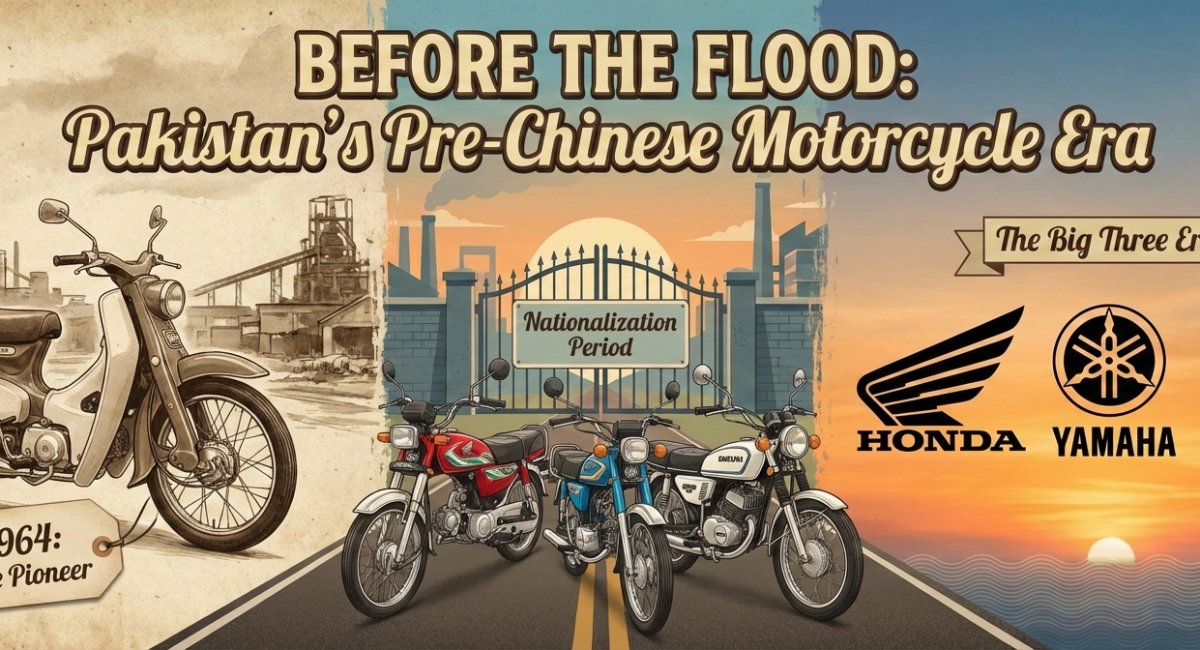
Before the Flood: The Highs and Lows of Pakistan’s Motorcycle Industry (The Pre-Chinese Era)
If you stand on a street corner in Lahore or Karachi today, the sound of traffic is a chaotic symphony dominated by a single note: the buzzing whine of thousands of identical 70cc engines. It is the sound of affordable mobility, brought on by the wave of Chinese technology in the mid-2000s.
But travel back in time before that wave—before the market was flooded with “Chondaz” and rebranded replicas—and you find a very different landscape.
Today, we are diving deep into the history books. We are looking at the foundation of Pakistan’s two-wheeler industry. It is a story of visionary pioneers, the disruptive force of nationalization, and the eventual rise of an oligopoly that defined mobility for generations.
This is the story of the Pakistani motorcycle industry: The Pre-Chinese Era.
### Part 1: The Genesis – The Pioneers Arrive (The Highs)
The early 1960s in Pakistan were marked by a drive for industrialization. The country was young, the economy was growing, and the need for personal transport was becoming apparent.
While many associate the start of the industry with motorcycles, the very first two-wheelers to be progressively manufactured in Pakistan were actually scooters. In **1962**, Wazir Ali Engineering partnered with the Italian giant Lambretta. Soon after, the iconic Vespa scooters began rolling out through Raja Auto Cars. These machines were stylish and urban, but Pakistan needed something tougher for its developing infrastructure.
**Enter the Titan: Atlas Honda**
The true turning point—the moment the *motorcycle* industry was truly born—happened because of a handshake between two visionaries.
In **1963**, Mr. Yusuf H. Shirazi, the founder of the Atlas Group, signed a technical assistance agreement with the legendary Soichiro Honda in Tokyo. It was a massive win for Pakistan to secure a partnership with a growing Japanese powerhouse.
By **1964**, commercial production began at their Karachi plant. This was the birth of **Atlas Autos Limited** (now Atlas Honda), the undisputed pioneer of the Pakistani motorcycle industry.
**The Early Wins:**
It wasn’t about mass production yet; they started by making just seven bikes a day. But the machines they introduced were game-changers. The **Honda C50**, the rugged **C90**, and the sporty **S90** were introduced to the market. In 1965, Atlas became the first two-wheeler company listed on the Pakistani stock exchange. The future looked incredibly bright.
### Part 2: The Disruption – The Shadow of the 70s (The Lows)
Just as the industry was finding its footing, the political winds shifted dramatically in the 1970s. This decade brought the policy of Nationalization.
While intended to empower the state, nationalization threw a massive wrench into the gears of private industrial progress. The motorcycle industry was not spared.
The “High” of early innovation was replaced by the “Low” of bureaucratic stagnation. The government took over management of many industrial units. The focus shifted away from introducing new models or competing on technology, and toward mere survival and meeting basic demand under heavy regulation.
It was during this difficult, confusing era that other major players entered the field, trying to navigate a state-controlled landscape. **Dawood Yamaha Ltd (DYL)** entered the fray in 1974, bringing the noisy but beloved 2-stroke engines. **Suzuki** followed soon after.
The stage was set, but the actors were constrained by government policy.
### Part 3: The Era of the “Big Three” Oligopoly (The Wins and Falls)
As the dust of nationalization eventually settled and policies shifted back toward privatization in the 80s and 90s, a new reality emerged. The Pakistani market became ruled by an “Oligopoly”—a market dominated by a small number of large sellers.
We called them The Big Three: **Honda, Yamaha (DYL), and Suzuki.**
**The Wins: Creating Icons**
This era defined what a motorcycle meant to a Pakistani. These companies built the infrastructure of the nation. They established dealerships in remote villages, ensured parts were available everywhere, and created machines renowned for bulletproof reliability.
This era gave us the legends that refuse to die:
* The **Honda CD70** (introduced in the mid-70s) became the gold standard of fuel economy—the “cash currency” of motorcycles.
* The **Honda CG125** became the symbol of power and sound for the youth.
* The **Yamaha 100** became the rugged workhorse of rural areas.
These bikes moved the nation’s workforce, its students, and its families. That was a massive win.
**The Falls: The Stagnation Trap**
However, this total dominance came at a heavy cost to the consumer. With high import tariffs protecting them from outside competition, and only three players in the market, innovation completely died.
For almost 30 years, the Pakistani consumer was sold the exact same technology. A Honda CD70 in 1985 was essentially the same machine in 2005, perhaps with a different sticker (the infamous “tanki-tappa” change).
Prices kept rising, but technology remained frozen in time. The industry was stable, highly profitable for the manufacturers, but deeply stagnant for the consumer. The “Big Three” had become too comfortable.
### Conclusion: The Stage is Set for Disruption
By the early 2000s, the pre-Chinese era had established a strong foundation. Pakistan had a skilled labor force, a massive vendor network for parts, and a population hungry for mobility.
But the market was also characterized by high prices and obsolete technology dictated by the Japanese monopoly. The average Pakistani was finding it harder to afford a brand new Honda or Yamaha.
The industry had hit a plateau. It was a fortress built on reliability but rusted by a lack of competition. The environment was perfectly primed for a disruption that would shatter the status quo.
That disruption was waiting just across the border, ready to change the sound of Pakistani streets forever. But that is a story for another day.
Leave a Comment