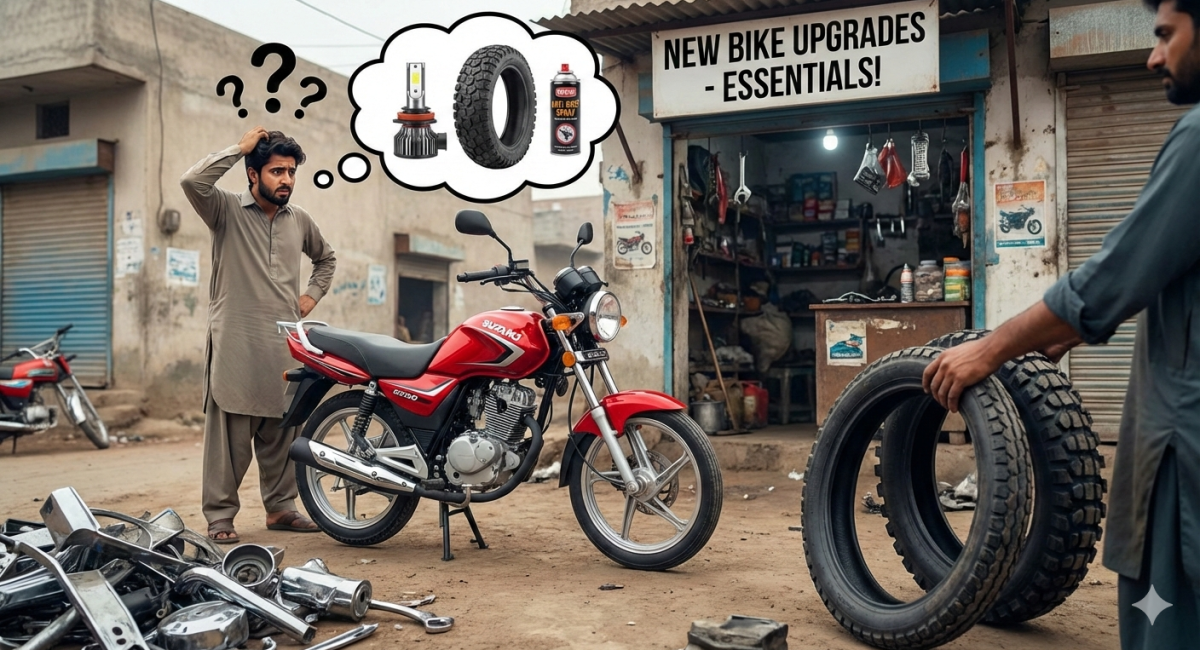
The Hidden “New Bike Tax”: Why Pakistani Bikers Upgrade Immediately
ou’ve finally done it. You saved up, braved the dealership, and rode home on a brand-new Suzuki GS150. It’s a “zero-meter” bike, the ultimate symbol of reliability, right? Yet, within 48 hours, you find yourself at a local workshop, spending another 30,000 to 50,000 PKR on tyres, lights, and coatings.
It feels counterintuitive. Why should a factory-fresh machine require immediate “fixing”? In Pakistan, buying a bike is often just buying the “base engine and frame.” To make it safe and durable for our roads, you have to pay what many call the hidden “New Bike Tax.”
1. The Rubber Reality: Trading Plastic for Grip
The most common upgrade is the tyres. Stock tyres on most Pakistani bikes (including the GS150) are often made of “hard compound” rubber. While these last for years without wearing down, they offer almost zero traction on wet asphalt or sandy corners.
For a GS150 owner, the stock rear tyre feels thin and “skiddy.” Upgrading to a wider, soft-compound tyre like a 100/90-18 (from brands like Timsun or MRF) isn’t about “looking cool”—it’s about survival. It transforms the bike from a wobbling bicycle into a stable machine that actually stops when you hit the brakes.
2. Piercing the Darkness: The “Candlelight” Problem
If you’ve ever ridden a stock GS150 on a highway at night, you know the struggle. The factory-fitted 35W halogen bulb provides what bikers jokingly call “candlelight.” In a country with frequent street light outages and high-beam-blinded oncoming traffic, a weak headlight is a death trap.
Bikers switch to high-intensity LEDs or auxiliary “fog lights” to actually see the potholes before they hit them. It’s an essential safety upgrade that manufacturers skip to save a few hundred rupees in production costs.
3. The Fight Against Corrosion: The Vanishing “Chamak”
Twenty years ago, a Suzuki’s chrome would shine for a decade. Today, if you live in a humid city like Karachi or Lahore, a new bike can start showing “freckles” of rust within the first rainy season.
The quality of chrome plating and paint has declined as manufacturers struggle with rising material costs. To protect their investment, smart owners immediately invest in anti-rust sprays, ceramic coatings, or under-seat painting. If you don’t do it in the first week, the rust sets in, and the resale value plummets.
Why Do Manufacturers Do This?
It boils down to cost-cutting and competition. To keep the “sticker price” of a GS150 or YBR attractive in an economy hit by inflation, manufacturers compromise on “consumables”—things they know the customer can replace later. They prioritize the engine and gearbox (the expensive parts) and skimp on the tyres, bulbs, and plating quality.
The Verdict
Buying a bike in Pakistan is a DIY project. You aren’t just buying a vehicle; you’re buying a canvas. While it’s frustrating to spend more money on a “new” product, these upgrades are what turn a generic commuter into a reliable partner for our unique road conditions.
Leave a Comment