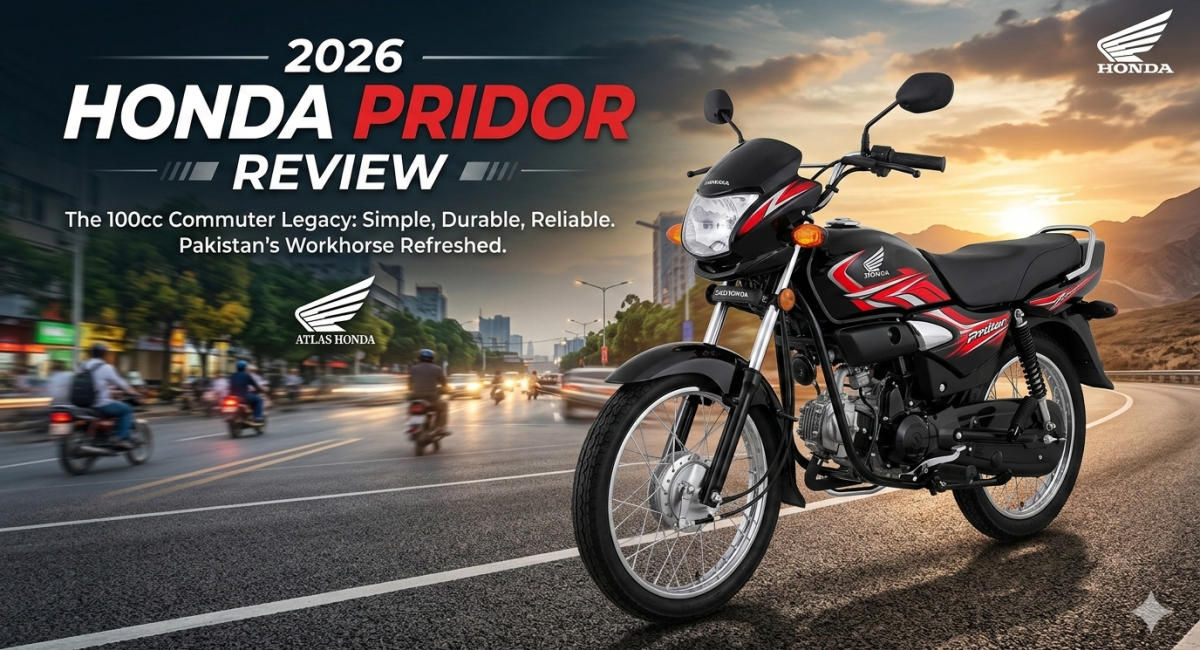
Atlas Honda Introduces 2026 Pridor – A Simple, Reliable 100cc Commuter
The 2026 Honda Pridor has officially hit the Pakistani market, and while it isn’t reinventing the wheel, it remains a steadfast player in Atlas Honda’s lineup. If you were expecting a radical overhaul, you might be disappointed—but for the pragmatists among us, the 2026 Pridor is exactly what it needs to be: a reliable workhorse.
Here is an enriched breakdown of how the latest model measures up.
Design & Aesthetics: A Fresh Coat of “Same”
The most visible change for 2026 is the updated sticker work and decals. Atlas Honda has opted for a “renewed” aesthetic rather than a structural redesign. While some enthusiasts might find this lack of innovation underwhelming, it keeps the Pridor looking contemporary enough to stay relevant on the road.
Mechanical Specs: The Power of Consistency
Underneath the new graphics, the Pridor remains a familiar beast. It retains the tried-and-tested 100cc OHC engine, known for its balance of fuel economy and smooth power delivery.
Engine: 100cc 4-Stroke, Single Cylinder.
Transmission: 4-speed constant mesh.
Suspension: Conventional telescopic forks (front) and swingarm with dual shocks (rear).
By avoiding “experimentation,” Honda ensures that every mechanic in the country already knows how to fix this bike, and every spare part is already sitting on a shelf somewhere.
Market Positioning: The Lone Wolf
The Pridor occupies a unique “Goldilocks Zone” in Pakistan’s motorcycle landscape:
Step up from 70cc: It offers more road presence and torque than the entry-level CD70.
Economical alternative to 125cc: It is significantly easier on the wallet regarding fuel and maintenance than a CG125.
As the only 100cc offering from a Japanese manufacturer in the country, it effectively owns this niche, catering to riders who want a bit more “oomph” without the vibration and fuel cost of a larger engine.
Build Quality vs. Modern Features
Where the Pridor truly wins is in its structural integrity. Compared to budget competitors, the fit and finish are noticeably superior.
Durability: Better paint quality and thicker materials mean fewer rattles after a year of use.
The Trade-off: It is undeniably a “back-to-basics” machine. You won’t find digital clusters, LED headlights, or USB charging ports here. It is an analog bike in a digital world.
The Verdict: For the rider who views their motorcycle as a tool rather than a toy, the Pridor’s lack of gadgets is actually a plus—there are fewer electronic components to fail over time.
The Value Proposition
The 2026 price tag remains a point of contention. It is priced at a premium for a 100cc bike, but that cost is offset by three critical factors:
Brand Trust: The peace of mind that comes with the “Wing” logo.
Resale Value: In Pakistan, a Honda is practically liquid cash; it holds its value better than almost any other brand.
Service Network: Atlas Honda’s massive dealership footprint means help is never far away.
Final Thoughts
The 2026 Honda Pridor isn’t trying to be a game-changer; it’s a legacy-builder. It is a no-nonsense commuter designed for the daily grind, prioritizing longevity over “flashy” upgrades. If you value Japanese engineering standards and a bike that will likely outlive its rivals, the Pridor remains a solid, albeit conservative, investment.
Leave a Comment